Blog | December 21, 2023
When manual processes reach their limits
Use cases for successful supply chain automation
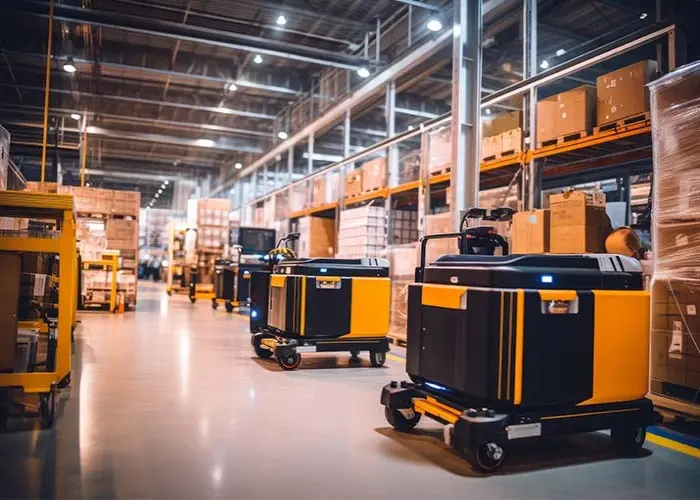
Businesses generally automate processes to add economic value. A classic example of process automation is using technology to increase production quantities while keeping operating costs stable. In contrast, manual production requires significantly higher costs to yield comparable quantities – that is, if production processes can even be performed manually. A standard planning approach is often used to plan this kind of production system. If the motivation for automating processes is not financial, but rather due to factors like infrastructure limitations or environmental conditions, planning becomes more challenging. In line with product and process requirements, businesses need to select reliable technology while also guaranteeing cost-optimal operations.
Below, we’ve compiled a few examples where manual processes are complicated or completely ruled out. The examples cover a wide range of industries, including automotive, grocery production and retail, as well as e-commerce, high-tech and industrial manufacturing.
Theft protection thanks to automation
Handling and storing articles with high value requires special security measures. For instance, products like injectors for truck motors, brand-name items, jewelry, valuable metals, money or the raw materials used to make these items often require extra protection from theft or misuse. The same may be true of parts for tools and machines for essential functions, such as military use.
Even if manual processes are simple to implement in these cases, businesses often choose automation technology. This way, unauthorized access to the relevant areas of the plant is prohibited for safety reasons, creating a first hurdle for potential theft. For greater protection, security and surveillance technology can be implemented as needed. In addition to physical processing, warehouse management should also be made secure during the process design phase, for instance to prevent misuse and theft of valuable items during booking processes.
Businesses can usually cover the additional costs for processes with high security requirements by increasing the price of the end products, as competitors also face these costs. Such products are generally sold at a high margin, which also reduces price pressure.
Online retail is booming – and so is the packaging industry
"Remember Covid, when all the stores were closed? Thank goodness we had and still have Amazon and more to get us through it all." You may have found yourself thinking something like this. During the Covid-19 pandemic, manufacturers of packaging, and especially cardboard packaging, needed to nearly double their output to meet the demand of large online retailers. And the boom has continued even after the pandemic.
How do these businesses adjust production to meet such an increase in demand? Just as in the above examples: by adapting quickly with automation. For example, many manufacturers of cardboard packaging switched their production and logistics from partial to full automation within a very short time – in some cases, under 10 months. The line feeding of the long, large machines in factories was operated by manual forklifts and manual processes. But with machines doubling their output, workers could no longer move quickly enough to keep up. Interlinked conveyor technology provides a solution and reduces process times by as much as 30% with line feeding. By linking the automatic high-bay warehouse directly to the machines using driverless transportation systems, the cut-to-size and palletized cardboard boxes are stored ready for distribution. This further improves efficiency and increases delivery cycles to the customer. In this example, logistics sets the pace for the factory, enabling a quick response to increasing customer requirements.
High throughput with maximum precision
In electric manufacturing, electronic components are placed on circuit boards with impressive speed and precision. Hourly throughputs of more than 10,000 components, some less than one millimeter long, are not unusual. In food production, quality control is slower, but still incredibly fast for the human eye. Delta and SCARA robots sort food products such as chocolates into their packaging quickly, yet with the care required. They also use cameras to sort out faulty products in quality inspection processes. In both examples, speed, accuracy and hygiene requirements are high within the working environment.
With such large throughputs, businesses would need significantly more workers than robotic systems to maintain the necessary pace. When done by hand, accuracy and precision can only be maintained for a short time before reject rates increase significantly. As an additional advantage, robots don’t bring foreign particles into production areas. Contamination by dirt or germs can be avoided with appropriate technology. As mass production is generally well suited for automation, business cases demonstrate the benefits of automated processes.
Looking to the future
As demonstrated with these projects, processes in many industries stand to benefit from automating material flows or handling. In our current projects and conversations with customers, we see a trend toward digitized and automated solutions. Rising wages, the lack of skilled workers – particularly in view of demographic trends – and the replacement of outdated equipment frequently convince even hesitant businesses to invest in process automation.
At the same time, it’s important to note that automation has benefits beyond the financial ones. For instance, space, building or environmental requirements can limit manual processes. Lean processes, scalable automation and comprehensive digitization of production logistics will be key factors for remaining competitive in the future.
This article was originally published in German under the title “Limits manueller Prozesse” in the “Irgendwas mit Logistik” report number 8 in October 2023 on page 17.
Sounds interesting? Let's get in touch!
With over 20 years of process expertise, 4flow works with customers to identify, specify, tender and implement solutions. 4flow experts use a holistic approach to design production and supply chain processes aligned with customers’ requirements and provide innovative ideas in the process. With an integrated view of the customer, production, logistics and supplier, we create transparency along the entire process chain, identify waste and optimize end-to-end processes.
Process design based on lean management principles is still relevant in our opinion. Clear material flow orientation, standardization, transparency, waste avoidance and other lean principles are the cornerstones of process planning. To successfully solve these planning challenges, 4flow creates a digital twin of the plant using modern planning software.
In this way, logistics, production and assembly areas can be mapped, integrated and optimized realistically. 4flow accompanies you from the planning to implementation of automation solutions. You benefit from our industry expertise as we work together to select the most suitable technologies for your business. From automated warehouse technology and driverless transportation systems to automated provisioning in production and assembly areas, production logistics offers many starting points for automation – and thus helps businesses meet changing requirements. Compared to the past, today's automation solutions are no longer set in stone. They are flexible in terms of layout and scalable to support gradual investment based on business development.
Are you considering automating complex processes in your supply chain? 4flow works with you to develop and implement your individual objectives.